|
A SIMPLE VIEW OF ATOMIC STRUCTURE This page revises the simple ideas about atomic structure that you will have come across in an introductory chemistry course (for example, GCSE). You need to be confident about this before you go on to the more difficult ideas about the atom which under-pin A'level chemistry. The sub-atomic particles Protons, neutrons and electrons.
| |||||||||||||||||
|
Beyond A'level: Protons and neutrons don't in fact have exactly the same mass - neither of them has a mass of exactly 1 on the carbon-12 scale (the scale on which the relative masses of atoms are measured). On the carbon-12 scale, a proton has a mass of 1.0073, and a neutron a mass of 1.0087. | |||||||||||||||||
|
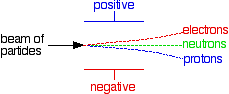
The behaviour of protons, neutrons and electrons in electric fields What happens if a beam of each of these particles is passed between two electrically charged plates - one positive and one negative? Opposites will attract. Protons are positively charged and so would be deflected on a curving path towards the negative plate. Electrons are negatively charged and so would be deflected on a curving path towards the positive plate. Neutrons don't have a charge, and so would continue on in a straight line. Exactly what happens depends on whether the beams of particles enter the electric field with the various particles having the same speeds or the same energies If the particles have the same energy If beams of the three sorts of particles, all with the same energy, are passed between two electrically charged plates:
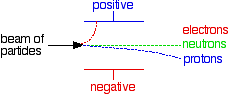
If the electric field was strong enough, then the electron and proton beams might curve enough to hit their respective plates. If the particles have the same speeds If beams of the three sorts of particles, all with the same speed, are passed between two electrically charged plates:
| |||||||||||||||||
|
Note: This is potentially very confusing! Most chemistry sources that talk about this give either one or the other of these two diagrams without any comment at all - they don't specifically say that they are using constant energy or constant speed beams. But it matters! If this is on your syllabus, it is important that you should know which version your examiners are going to expect, and they probably won't tell you in the syllabus. You should look in detail at past questions, mark schemes and examiner's reports which you can get from your examiners if you are doing a UK-based syllabus. Information about how to do this is on the syllabuses page. If in doubt, I suggest you use the second (constant speed) version. This actually produces more useful information about both masses and charges than the constant energy version. | |||||||||||||||||
|
The nucleus The nucleus is at the centre of the atom and contains the protons and neutrons. Protons and neutrons are collectively known as nucleons. Virtually all the mass of the atom is concentrated in the nucleus, because the electrons weigh so little. Working out the numbers of protons and neutrons
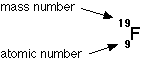
The atomic number is also given the more descriptive name of proton number.
The mass number is also called the nucleon number. This information can be given simply in the form:
How many protons and neutrons has this atom got? The atomic number counts the number of protons (9); the mass number counts protons + neutrons (19). If there are 9 protons, there must be 10 neutrons for the total to add up to 19. The atomic number is tied to the position of the element in the Periodic Table and therefore the number of protons defines what sort of element you are talking about. So if an atom has 8 protons (atomic number = 8), it must be oxygen. If an atom has 12 protons (atomic number = 12), it must be magnesium. Similarly, every chlorine atom (atomic number = 17) has 17 protons; every uranium atom (atomic number = 92) has 92 protons. Isotopes The number of neutrons in an atom can vary within small limits. For example, there are three kinds of carbon atom 12C, 13C and 14C. They all have the same number of protons, but the number of neutrons varies.
These different atoms of carbon are called isotopes. The fact that they have varying numbers of neutrons makes no difference whatsoever to the chemical reactions of the carbon. Isotopes are atoms which have the same atomic number but different mass numbers. They have the same number of protons but different numbers of neutrons. The electrons Working out the number of electrons Atoms are electrically neutral, and the positiveness of the protons is balanced by the negativeness of the electrons. It follows that in a neutral atom:
So, if an oxygen atom (atomic number = 8) has 8 protons, it must also have 8 electrons; if a chlorine atom (atomic number = 17) has 17 protons, it must also have 17 electrons. The arrangement of the electrons The electrons are found at considerable distances from the nucleus in a series of levels called energy levels. Each energy level can only hold a certain number of electrons. The first level (nearest the nucleus) will only hold 2 electrons, the second holds 8, and the third also seems to be full when it has 8 electrons. At GCSE you stop there because the pattern gets more complicated after that.
These levels can be thought of as getting progressively further from the nucleus. Electrons will always go into the lowest possible energy level (nearest the nucleus) - provided there is space. To work out the electronic arrangement of an atom
e.g. to find the electronic arrangement in chlorine
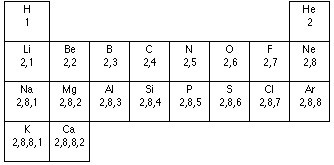
The electronic arrangements of the first 20 elements
After this the pattern alters as you enter the transition series in the Periodic Table. Two important generalisations If you look at the patterns in this table:
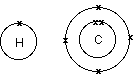
Dots-and-crosses diagrams In any introductory chemistry course you will have come across the electronic structures of hydrogen and carbon, for example, drawn as:
| |||||||||||||||||
|
Note: There are many places where you could still make use of this model of the atom at A'level. It is, however, a simplification and can be misleading. It gives the impression that the electrons are circling the nucleus in orbits like planets around the sun. As you will find when you look at the A'level view of the atom, it is impossible to know exactly how they are actually moving. | |||||||||||||||||
|
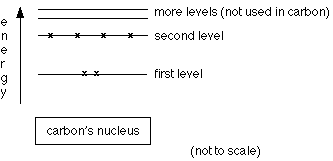
The circles show energy levels - representing increasing distances from the nucleus. You could straighten the circles out and draw the electronic structure as a simple energy diagram. Carbon, for example, would look like this:
Thinking of the arrangement of the electrons in this way makes a useful bridge to the A'level view. | |||||||||||||||||
|
Note: If you have come to this page as a UK GCSE student (or a student on a similar introductory chemistry course elsewhere) and want some more help, you may be interested in my GCSE Chemistry book. This link will take you to a page describing it. | |||||||||||||||||
 © Jim Clark 2000 (last updated July 2010) |
|||||||||||||||||
 No of protons = ATOMIC NUMBER of the atom