| Understanding Chemistry | |
|
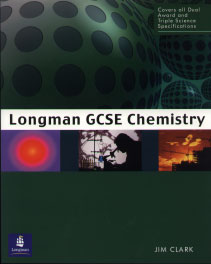
LONGMAN GCSE CHEMISTRY (March 2013: The book is now out of print, but if you are interested, you may be able to obtain a second-hand copy from Amazon.co.uk.)
If you are simply interested in a general-purpose introduction to chemistry for 14 - 16 year-olds, you might be better looking at my Edexcel IGCSE Chemistry book. This contains rather less material than the GCSE book (because it only covers one syllabus rather than five in the GCSE book), but is an equally good foundation on which to go on to chemistry at a higher level. There is also more support available via the website that this link will lead you to. The Longman GCSE book was written to cover the chemistry content of all the UK GCSE Chemistry syllabuses at the time (2002). It is aimed at students likely to achieve grades from A* to B, and written in a way that wouldn't cause problems for students going on to do chemistry at a higher level. However, since then, GCSE syllabuses have changed, particularly in the order in which they do things, and with more stress on making chemistry "relevant" - some would argue, more dumbed down! This book will therefore no longer match the approach of some modern GCSE chemistry syllabuses. It does, however, contain virtually all the chemistry that you will need for the new syllabuses (almost certainly more than you will need), presented in a logical order that will help you to make a smooth transition from GCSE to A level (or its equivalent) if that's what you want to do later. If you are working in another system, GCSE in the UK is an exam taken at the end of a (usually) two year course at the age of 16. Anyone taking a similar introductory chemistry course may find the book helpful. What the GCSE book covers The book is organised into 6 sections plus an important appendix. Each section is made up of a number of related chapters. There are questions at the end of each chapter to test understanding, and a set of GCSE-style exam questions at the end of each section. Answers to all the questions are provided on the supporting website - although these are password-protected so that only teachers can get at them! Section A: Particles This covers an introduction to atomic structure and bonding (including metallic bonding and intermolecular forces) and the relationship between the structures of elements and compounds and their physical properties. There is also a chapter on how to write formulae and equations, and a final one on the factors affecting rates of reaction together with explanations. Section B: Some essential background chemistry This is a lengthy section which covers the important lab-based chemistry:
Section C: Large scale chemistry This covers the extraction of several metals, and the chemistry of salt and limestone. It introduces reversible reactions leading to the Haber and Contact Processes. Section D: Air, water and earth Discusses the atmosphere (including its evolution and some environmental problems), water (including hardness, water treatment, and an introduction to colloids) and types of rock. Section E: Organic chemistry An introductory look at the oil industry and some simple organic compounds (alkanes, alkenes, alcohols, carboxylic acids, and a brief look at esters). Structural isomerism is explained where it arises. There are also chapters on food and drugs, and enzymes. Section F: Sums This section deals with all the calculations involving relative atomic masses and moles up to and including simple titration and electrolysis calculations. Appendices The most important appendix explains how to maximise your score when writing up coursework practical investigations to satisfy the requirements of UK GCSE examiners. (This is no longer relevant to the modern GCSE courses, but might still be interesting.) The fully written out investigation is available from the website accompanying the book. The website There is a website to accompany the book which you can find by following this link. Go to Main Menu . . . © Jim Clark 2003 (last modified March 2013) |