Understanding Chemistry


CHEMISTRY CALCULATIONS

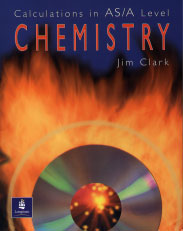
There are virtually no calculations on this site, but you might be interested in my chemistry calculations book.

If you have found this site helpful, you should find the book will help you as well.

Don't be misled by the book's title! It was written to cover all the calculations in UK AS and A level chemistry syllabuses (roughly for ages 16 - 18 years), but chemistry calculations are just the same wherever in the world you are working.

Compare what you are expected to know with the list of things that the book covers (see below).


Happy readers!

Jim Clark takes you step by step through all the examples in this book using simple basic mathematics that even a primary schooler could do. i never really liked maths nor anything to do with calculations so i got this book and within a few months i was really confident with my calculations . . . so get this book!!

From a user review on Amazon.co.uk

This book is a godsend as far as calculations in Chemistry are concerned . . . Jim Clark is consistent in the methods he presents and explains them in a practical way that is easy to understand.

From a user review on Amazon.co.uk

This book is excellent in all aspects. Students frequently struggle with calculations and this book is very student friendly - the author carefully leads the reader through the main steps using a friendly writing style. An outstanding book - strongly recommended!!

From a user review on Amazon.co.uk

This is a really great book,it takes you step-by-step through every type of question you will come across in any A-level chemistry syllabus giving you loads of examples and practice questions along the way. I found it really easy to understand, and easier to revise,as it is directed towards exam questions. If you find any type of calculations hard, buy the book it is really good...

From a user review on Amazon.co.uk

This is an absolute MUST for ANY Chemistry student doing A levels! . . . I have reccomended this book to many friends and I am yet to find a better book that deals in calculations in this way.

From a user review on Amazon.com

. . fills a large gap in the market and provides excellent coverage . . . I shall recommend this to my students as a self-study aid and will certainly use it myself.

School Science Review, March 2001

This is an excellent book, . . . a 'must have' for teachers and students alike.

Times Educational Supplement, 27 April 2001


How to get hold of the book

You can, of course, buy the book through normal book sellers, but here is a direct link to Amazon.co.uk if you just want to read the most recent reviews (click on the picture or the title) or to buy the book.

Non-UK students can also buy the book from Amazon.co.uk, but will obviously have to pay a slightly higher delivery charge.


Note:  If you don't see an image here, it is probably because you are using ad-block software. The simplest way around this is to disable it temporarily and then reload this page.


How the book works

Each type of calculation is introduced in a very gentle way, making no great assumptions about your chemistry knowledge or maths ability. There are then lots of worked examples, gradually getting more difficult and showing as many variations on a calculation as possible.

At the end of each section there are a set of problems for you to do, based firmly on what has gone before. At the back of the book, you will find complete worked solutions to these problems.

At the end of each chapter, you will find another set of problems covering the ground again. This time, numerical answers are given for the problems - but no worked solutions.


What the book covers

Chapter 1: Formulae, Equations and Oxidation States

This chapter starts from a very simple level and teaches you how to write formulae and to work out equations, including ionic equations. It also covers oxidation states and their uses. Although it starts simply, by the end of this chapter you will be able to write equations for some very complicated reactions.

Chapter 2: Basic Calculations Involving Formulae and Equations

Covers relative atomic mass (and how it can be found from a mass spectrum), relative formula mass, moles (including the Avogadro Constant), finding empirical and molecular formulae, calculations from equations, and percentage yield calculations.

Chapter 3: Basic Calculations Involving Gases

Includes Avogadro's Law and its uses, the molar volume of a gas (including calculations from equations involving gases), and the ideal gas equation.

Chapter 4: Basic Calculations Involving Solutions

Describes how to do calculations from equations involving solutions (including how to derive equations from experiments), and then looks in detail at titration calculations. It starts with simple acid-base titrations and then gradually progresses to more difficult examples, including back titrations and "double indicator" titrations.

Chapter 5: Thermochemistry

Starts by looking at how you process the results of thermochemistry experiments, and then goes on to look at all the variations on thermochemistry calculations that you are likely to meet at this level.

Chapter 6: Orders of Reaction

Starts by explaining what is meant by orders of reaction, and then looks in detail at how you can work them out from experimental data - by exploring tabulated data from initial rate experiments or by processing results graphically. It also considers the effect of temperature on rates of reaction, and how this can be used to find activation energies.

Chapter 7: Chemical Equilibria

Looks at calculations involving both Kc and Kp for both homogeneous and heterogeneous equilibria. The work on Kp necessarily covers such things as mole fractions and partial pressures.

Chapter 8: Acid - Base Equilibria

Defines pH and shows how to work out the pH of strong acids and bases and of weak acids and bases. As a part of this, it necessarily covers things like Kw, Ka and pKa. Also shows how to calculate pH changes during simple acid-base titrations. Discusses how buffer solutions work and how to calculate the pH's of both acidic and basic buffers.

Chapter 9: Other Equilibria

Covers solubility product, partition coefficients and Henry's Law.

Chapter 10: Redox Equilibria

Starts with a long introductory section to help you to understand the origin of electrode potentials (redox potentials) - because most text books try to do this too quickly and leave you confused! Looks at simple calculations involving electrode potentials, and how they can be used to predict the feasibility of redox reactions.

Chapter 11: Entropy and Free Energy

Discusses entropy and entropy changes in as simple a way as possible - and looks at the way total entropy change governs the feasibility of a reaction. Goes on to look at free energy changes and how they can be calculated and used to predict feasibility.


Go to Main Menu . . .


© Jim Clark 2000 (last modified 2008)